


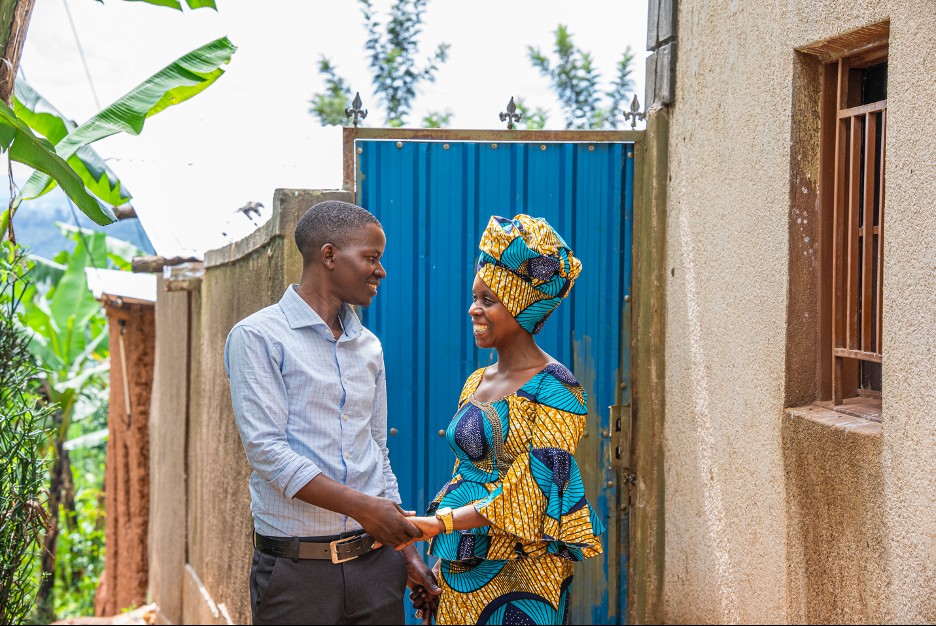
Equal Partners, Brighter Future : Wivine and Alexis story
“I felt like I was carrying all the burdens alone, living with a disability while also lacking support at home felt like a wound on another wound,” said Wivine Muhayuwera, a 35-year-old, mother of three, successful poultry farmer, chilli producer and entrepreneur.
As a person with a physical disability, with only one arm fully functioning, Wivine was struggling to survive with a small poultry activity of 20 chickens. The 30,000 RWF monthly income was barely enough to buy soap and basic household needs. At home, verbal abuse and lack of shared responsibility created tension and emotional suffering within the family. Through SERVE Project, Wivine received technical training in poultry farming, entrepreneurship, and financial management. She also benefited from group-based learning and peer support mechanisms that helped participants improve production practices and access better market opportunities.
“The trainings transformed both my business and my family. I learned how to professionally rear chickens, manage feeds properly and increase profits. But I also learned the importance of dialogue, partnership and complementarity within the household,” Wivine explains.
Using the skills she gained, she gradually expanded her poultry business from 20 chickens to hundreds. Recently, she sold a batch of 500 chickens and has now ordered 1,000 chicks as part of her growing business.
Beyond poultry farming, Wivine also ventured into chilli farming and value addition by processing and packaging chilli products for sale. Today, the chilli business alone generates approximately 150,000 RWF per month. Combined with her poultry business, her monthly earnings have risen to approximately 350,000 RWF. “The biggest change is the harmony in our family. Now my husband and I consult each other, plan together and support each other. We are finally working as one,” she says.
Today, her husband Alexis Niyongira cooks, cleans, washes clothes and actively participates in raising their children ; responsibilities he once believed belonged exclusively to women.
“The first thing he gives me now is peace of mind, before, I would feel heartbroken because I could not even peel potatoes due to my disability while he sat there believing it was not his responsibility. Now he volunteers to help without even being asked,” Wivine says emotionally.
A major part of this transformation came through the “Journey of Transformation” training facilitated by Pro-Femmes Twese Hamwe in Rwamagana District, which focuses on gender equality, equitable decision-making, and positive masculinity within families ; helping couples shift from individual to shared responsibility. Before the training, her husband Alexis believed household chores and childcare were solely women’s responsibilities. Today, the couple works together as equal partners.
“Now my husband cooks, cleans, supports the children and we make financial decisions together. We are now functioning as one team,” Wivine says proudly.
Alexis says the training completely changed how he understood marriage, partnership and masculinity. He admitted to not trusting his wife, hiding money from her and there was no unity or dialogue in the home.
“Pro-Femmes revived my marriage ; they taught me that my wife and I are one team and that we should complement each other. Growing up, I had never seen men do household chores, so I believed it was wrong for men to cook or clean. But after the training, everything changed,” he says.
The couple began combining their finances, jointly planning investments and working toward shared goals. Within months, they expanded the poultry business, purchased a new motorcycle for transport services, renovated their home and installed running water. “We realized we had wasted so much time because we were not working together,” Alexis says.
Today, the family dreams even bigger. They recently ordered a hatching machine with the capacity to hatch 2,000 chicks, which will allow them to produce their own chicks instead of purchasing them externally. The couple also dreams of owning a vehicle to support their growing enterprises. “If buying and raising 1,000 chicks can generate around 500,000 RWF profit, hatching our own chicks could double the profit. In the next two years, I want to own a car that supports our businesses and become a woman who confidently shares her testimony with others,” Wivine explains.
Today, Wivine and Alexis are role models within their community. Neighbors who once criticized Alexis for supporting his wife now seek his advice after witnessing the family’s progress. For Wivine, the journey is proof that women and girls, including those living with disabilities, can thrive when given opportunity, skills and support.
“My message to women and girls is to believe in themselves and dare to start small. If I dared as a woman living with a disability, others can do it too,” she says.
Lorem Ipsum has been the industry’s standard dummy text ever since the 1500s, when an unknown printer took a galley of type and scrambled it to make a type specimen book.
Lorem Ipsum has been the industry’s standard dummy text ever since the 1500s, when an unknown printer took a galley of type and scrambled it to make a type specimen book.
Lorem Ipsum has been the industry’s standard dummy text ever since the 1500s, when an unknown printer took a galley of type and scrambled it to make a type specimen book.
Lorem Ipsum has been the industry’s standard dummy text ever since the 1500s, when an unknown printer took a galley of type and scrambled it to make a type specimen book.